How to Become an Elevator Installer and Repairer (2026)

Elevator installers and repairers are the highest-paid construction trade workers in the US — with a mean annual wage of $109,820 (BLS, May 2025), they out-earn electricians, plumbers, and HVAC technicians by a wide margin. If you’re researching how to become an elevator installer and repairer, the short answer is: complete a four- to five-year apprenticeship through the International Union of Elevator Constructors (IUEC), pass your state’s licensing exam, and you’ll have a career with strong job security and wages that rival many college-educated professions.
The trade is small — about 23,790 elevator mechanics are employed nationwide (BLS, May 2025) — but demand is steady and the barriers to entry are well-defined. This guide covers every step of the path, what the work actually looks like, what you’ll earn at each stage, and what it takes to get licensed.
Table of Contents
Quick facts: Elevator Installer and Repairer
- Training time: 4–5 year IUEC apprenticeship (earn while you learn)
- Starting salary: ~$50,000–$65,000/yr during apprenticeship
- Mean annual wage: $109,820/yr (BLS, May 2025)
- Median annual wage: $109,910/yr — $52.84/hr (BLS, May 2025)
- Top 10% wage: $158,890/yr (BLS, May 2025)
- License required: Yes — most states require a state elevator mechanic license
- Job outlook: 5% growth projected 2024–2034, ~2,000 openings/yr (BLS)
- Union: Most work through the IUEC (International Union of Elevator Constructors)
What elevator installers and repairers actually do
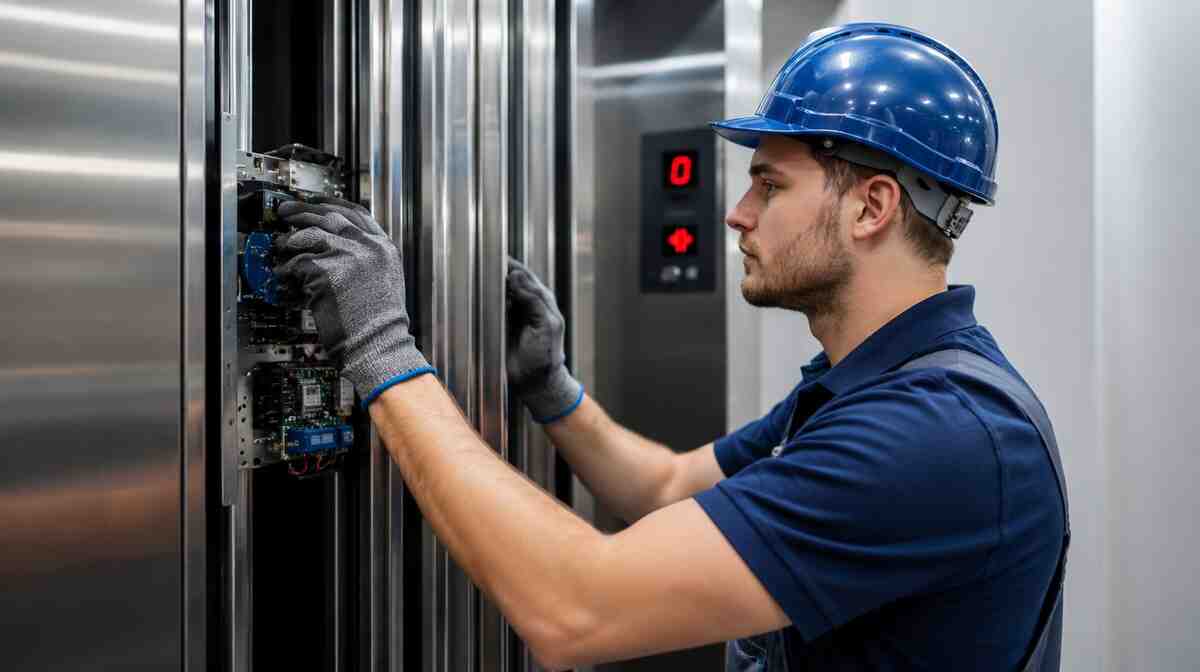
Elevator mechanics — the industry term most workers use — install, maintain, and repair elevators, escalators, moving walkways, dumbwaiters, and other vertical transport equipment. The job is split roughly into two categories: construction work, where you install new elevator systems in buildings under development, and service and maintenance work, where you keep existing equipment running safely and legally.
On the installation side, the work is physically demanding and complex. You’ll be assembling elevator cars, installing guide rails, wiring electrical systems, connecting hydraulic equipment, and programming computerized controllers. A single elevator installation in a high-rise can take weeks. You’re working in elevator shafts — often at height, in tight spaces, in buildings that may still be under active construction.
Maintenance and repair work is faster-paced and more varied. You’ll respond to service calls when elevators break down, perform scheduled inspections, and handle the recurring testing that most states legally require. This side of the trade requires strong diagnostic skills — you’re reading schematics, testing circuits, and identifying mechanical faults. Elevator systems are a mix of mechanical, electrical, and hydraulic engineering, so the job rewards people who like solving problems across multiple systems. The physical demands are real: you’ll be kneeling, climbing, and working in confined shaft spaces regularly. Injury rates in the trade are higher than average, so situational awareness and safety discipline are non-negotiable.
The overwhelming majority of elevator mechanics work for Building Equipment Contractors, with 23,790 elevator mechanics employed nationally (BLS, May 2025). A smaller share works in manufacturing, government facilities, or educational institutions.
How to become an elevator installer and repairer: step-by-step
There is effectively one path into this trade: the IUEC apprenticeship program. Unlike some trades where community college programs or employer-based training are common entry points, elevator mechanics almost universally enter through a formal union apprenticeship. Here’s how the path works.
-
1
Meet the basic eligibility requirements You must be at least 18 years old and have a high school diploma or GED. Many IUEC locals require proof of algebra proficiency — if your high school transcript shows no algebra, you may need to take and pass a basic algebra test before applying. A valid driver’s license is typically required as well, since service mechanics travel between job sites. Some locals conduct a drug screening as part of the application process.
-
2
Find and apply to your local IUEC Joint Apprenticeship Committee (JAC) The IUEC operates through local unions across the US. Applications are handled by each local’s Joint Apprenticeship Committee (JAC). Visit the IUEC website (iuec.org) or apprenticeship.gov to find openings near you. Application windows are competitive and often brief — locals don’t post openings year-round. When a local is accepting applications, the process typically involves submitting your transcripts, completing an interview, and potentially taking a mechanical aptitude test. Apply to multiple locals if geography allows.
-
3
Complete the 4–5 year apprenticeship (earn while you learn) IUEC apprenticeships combine on-the-job training with classroom instruction. You’ll log approximately 8,000 hours of supervised field work over four to five years, alongside roughly 200–300 hours of related technical instruction per year. Apprentices are paid from day one — typically starting at 50–60% of journeyman scale and increasing by set percentages each year as you advance. At current journeyman wage rates in major metro areas, this means starting around $30–$40/hour and working up. You’ll learn to read blueprints, install elevator systems, troubleshoot electrical and hydraulic faults, and comply with safety regulations including ASME A17.1 (the national elevator safety code).
-
4
Pass your state elevator mechanic licensing exam Most states require a separate state elevator mechanic license before you can work unsupervised. Licensing requirements vary — some states use the QEI (Qualified Elevator Inspector) credential as a benchmark; others administer their own exams. The exams typically cover ASME A17.1 code, electrical theory, hydraulics, and safety regulations. Your apprenticeship training prepares you for this directly. Check with your state’s department of labor or building inspection authority for the specific requirements and exam schedule in your state.
-
5
Work as a journeyman elevator mechanic and pursue specialization After completing your apprenticeship and obtaining your license, you’re a journeyman elevator mechanic. From here, you can specialize in high-rise elevator installation, escalator systems, accessibility lifts, or move into inspection and compliance work. Some journeymen pursue the Certified Elevator Technician (CET) or Certified Elevator Inspector (CEI) credentials through the National Association of Elevator Contractors (NAEC). Others move into supervision, project management, or start their own elevator service companies. Continuing education is typically required to maintain your license and stay current with code updates.
Good to know: the non-union path is rare
A small number of elevator mechanics enter through non-union employers — some manufacturers like Otis, KONE, and Schindler run their own training programs for service technicians. These programs are less common and often harder to find. If you can’t get into an IUEC local near you, researching direct-hire training programs with major elevator companies is your next best option. However, union apprenticeship consistently delivers higher starting wages, defined advancement, and stronger long-term earnings — especially in major metro markets.
Elevator installer salary: what you can realistically earn
At a mean annual wage of $109,820 (BLS, May 2025), elevator mechanics earn more than almost any other construction trade worker in the US — and the median tells a similar story: $109,910 per year, or $52.84 an hour. The 75th percentile sits at $135,720 and the top 10% earn $158,890 or more. Even at the 25th percentile — roughly where newer journeymen land — the annual wage is $79,290. These are not entry-level numbers; apprentice wages are lower, but they’re still competitive.
What drives your earnings as an elevator mechanic: geographic location is the single biggest variable, followed by whether you’re on commercial installation work (which tends to pay more and offers more overtime) versus residential service work. Union membership also matters — IUEC members typically earn journeyman scale plus benefits including pension contributions, which is a substantial piece of total compensation.
| Wage Percentile | Hourly Wage | Annual Wage |
|---|---|---|
| 10th percentile | $28.49 | $59,270 |
| 25th percentile | $38.12 | $79,290 |
| Median (50th percentile) | $52.84 | $109,910 |
| 75th percentile | $65.25 | $135,720 |
| 90th percentile | $76.39 | $158,890 |
Source: BLS OEWS, May 2025. National figures for Elevator and Escalator Installers and Repairers (SOC 47-4021). Mean annual wage: $109,820.
Geography shifts these numbers significantly, though the most recent state-by-state breakdown BLS has published is still from May 2024 — the May 2025 state and metro area supplement hasn’t been released yet. Using the latest available state data, Hawaii led all states at $150,600 annual median, followed by Maine ($138,520), Nevada ($137,950), California ($137,340), and Oregon ($135,620). Even states in the middle of the pack — New York at $124,530 or Illinois at $130,070 — paid substantially above the national median. Expect these figures to shift somewhat once BLS publishes the May 2025 state estimates.
For a full breakdown, read our comprehensive salary guide Elevator Installer and Repairer Salary: What You Can Earn in 2026.
| State | Annual Median Wage |
|---|---|
| Hawaii | $150,600 |
| Maine | $138,520 |
| Nevada | $137,950 |
| California | $137,340 |
| Oregon | $135,620 |
| New Jersey | $134,590 |
| Massachusetts | $134,360 |
| Illinois | $130,070 |
| District of Columbia | $125,030 |
| New York | $124,530 |
| Missouri | $123,710 |
| Washington | $123,030 |
| Kansas | $121,500 |
| Maryland | $119,200 |
| Colorado | $117,770 |
Source: BLS OEWS, May 2024 (most recent state-level data available as of this update). Top 15 states by annual median wage for Elevator and Escalator Installers and Repairers. State-level May 2025 figures had not been released by BLS as of publication.
Pro tip: where the money concentrates
Metro area wages often exceed state medians by a wide margin. Based on the most recent BLS metro data available (May 2024), San Jose-Sunnyvale-Santa Clara, CA led all metro areas at $169,560 annually — followed by San Francisco-Oakland-Fremont at $164,020 and Honolulu at $150,600. If you’re willing to relocate to a high-density urban market, your earning potential as a journeyman elevator mechanic increases substantially. The highest-employing metro areas — New York-Newark-Jersey City, Los Angeles-Long Beach-Anaheim, and Miami-Fort Lauderdale — also tend to pay well above the national median. Updated metro figures will follow once BLS releases the May 2025 area supplement.
For a direct salary comparison across the trades, see our highest paying trade jobs rankings and the skilled trades salary calculator.
Licensing and certification requirements
Most states require elevator mechanics to hold a state-issued elevator mechanic license before they can work independently. The specifics vary significantly by state, but the core pattern is consistent: you need documented apprenticeship hours, passing scores on a written exam, and in many states, continuing education to renew.
The primary regulatory framework is ASME A17.1, the Safety Code for Elevators and Escalators. This code governs elevator design, installation, and maintenance requirements across the US and is the foundation for most state licensing exams. States update their adopted code versions on different schedules, so you need to verify which edition your state uses — ASME A17.1 is updated every few years.
A few credentialing options are worth knowing:
- State elevator mechanic license: The most common requirement. Issued by your state’s department of labor, building and safety, or a similar agency. Many states require IUEC completion plus a passing exam score.
- Certified Elevator Technician (CET): Issued by the National Association of Elevator Contractors (NAEC), the CET validates competency in elevator codes, electrical systems, and technical safety. It’s earned either by completing a recognized training program (NAEC, NEIEP, or equivalent) or through documented field experience, followed by a 160-question written exam. The CET is renewed annually and requires 10 continuing education hours per year. It’s particularly valuable for mechanics working outside the IUEC structure — non-union employers and independent contractors often look for it as a proxy for apprenticeship-equivalent knowledge.
- Certified Elevator Inspector (CEI) / QEI: For inspectors rather than mechanics — relevant if you want to move into the inspection side of the business.
Watch out: don’t assume your license transfers
Elevator mechanic licensing is not nationally reciprocal. A license issued in California does not automatically qualify you to work in New York or Texas. If you move states, expect to apply for a new license, potentially sit additional exams, and in some cases fulfill local continuing education requirements before you can work independently. Verify with the target state’s licensing authority before making a move.
Career path and advancement
The career path in the elevator trade is structured and predictable — which is one of its strengths. You enter as an apprentice, progress through annual pay increases tied to your apprenticeship agreement, and graduate to journeyman status after four to five years. From there, advancement branches in a few directions.
Journeyman elevator mechanic is where most workers spend the bulk of their careers. At journeyman scale in major markets, you’re earning six figures including benefits, with overtime potential during peak installation periods. Overtime is common and can push annual take-home significantly above your base rate — installation projects often run tight timelines, and 50- to 60-hour weeks are not unusual.
From journeyman, experienced mechanics typically move into one of three paths: foreman or general foreman, overseeing installation crews or service teams; elevator inspector, moving to the inspection and code compliance side (usually requiring additional licensing).
The primary route to becoming a licensed elevator inspector is the QEI (Qualified Elevator Inspector) certification, administered by NAEC and governed by the ASME QEI-1 standard. To qualify, you need at least four years of documented elevator industry experience plus one year specifically in inspections or witnessed testing, followed by a written exam. Many IUEC mechanics pursue the QEI after 5–8 years in the field. It opens the door to inspection roles with government authorities, insurance companies, and third-party inspection firms — often at comparable or better pay than active maintenance work, with a less physically demanding schedule.
Contractor/business ownership, particularly for service and maintenance operations. Starting an elevator service company requires significant capital for equipment and bonding, but the recurring revenue from maintenance contracts makes it a viable long-term play.
Pro tip
The QEI and CET are issued by different organizations with different eligibility paths. The CET (NAEC) is aimed at working technicians; the QEI (also NAEC, plus NAESA International and QEITF) is for those moving into inspection. If your goal is inspection work, plan for at least 5 years of field experience before applying — the QEI requires documented inspection hours, not just mechanic hours.
Installation / Construction track
- Higher hourly wages
- More overtime available
- Project-based work — high variety
- More physically demanding (new shaft work)
- Income can fluctuate with construction cycles
Service / Maintenance track
- More consistent, predictable schedule
- Recurring maintenance contracts = job stability
- Strong diagnostic and troubleshooting skills required
- On-call rotations common (nights/weekends)
- Path into inspection and compliance work
The trade is also relatively recession-resistant compared to general construction. Elevator maintenance contracts are legally mandated in most jurisdictions — building owners can’t simply defer required inspections or stop servicing elevators even in an economic downturn. New installation slows with construction, but the service side provides a stable floor.
For broader context on how elevator mechanics compare to other high-earning trades, see our guide to the highest paying trade jobs in the US.
Frequently asked questions
How long does it take to become an elevator installer and repairer?
The IUEC apprenticeship takes four to five years to complete. During that time, you’ll work full-time alongside journeyman mechanics and attend related technical instruction. After completing the apprenticeship, you’ll need to pass your state’s elevator mechanic licensing exam before working independently. So realistically, plan on five years from application to fully licensed journeyman status.
What is the elevator installer and repairer salary?
The mean annual wage for elevator installers and repairers is $109,820, with a median of $109,910 (BLS, May 2025). The top 25% of workers earn $135,720 or more, and the top 10% earn $158,890. Wages vary significantly by state — based on the most recent state data (May 2024), Hawaii, Maine, and Nevada are the highest-paying states. Apprentice wages typically start at 50–60% of journeyman scale and increase each year.
Do I need a college degree to become an elevator mechanic?
No. The standard path is a high school diploma or GED plus the IUEC apprenticeship program. Some IUEC locals require demonstrated algebra proficiency, but no college degree is needed. The apprenticeship itself provides the technical education — electrical theory, hydraulics, blueprint reading, and the ASME A17.1 safety code — needed to pass state licensing exams.
Is the elevator trade a good career?
By the numbers, elevator mechanics are the best-compensated construction trade workers in the US. The job is intellectually demanding — it requires knowledge of mechanical systems, electrical wiring, hydraulics, and computerized controls — and physically demanding, with regular work in confined shaft spaces at height. The downsides are real: the work carries injury risk, on-call rotation is common in service roles, and apprenticeship openings are limited and competitive. But for workers who get in, the long-term earnings and job stability compare favorably to many professions requiring four-year degrees.
How do I apply for an elevator apprenticeship?
Applications go through your local IUEC Joint Apprenticeship Committee (JAC). Start at iuec.org to find locals near you, or search apprenticeship.gov for registered programs. Application windows are not always open — locals recruit based on local demand, so you may need to check back periodically. When applications are open, you’ll typically submit proof of education, undergo an interview, and potentially take a mechanical aptitude test. Getting on the list early and applying to multiple locals improves your chances.
What states have the most elevator mechanic jobs?
Based on the most recent state-level BLS data (May 2024), New York employs the most elevator mechanics of any state (3,710 workers), followed by California (2,830), Florida (2,100), Texas (1,360), and Maryland (1,200). High-density urban markets with large commercial real estate sectors consistently offer the most openings and the highest wages. Updated state figures will follow once BLS releases the May 2025 state supplement.
What is the job outlook for elevator installers and repairers?
BLS projects 5% employment growth for elevator installers and repairers from 2024 to 2034, with roughly 2,000 job openings expected each year from growth, retirements, and workers leaving the field. Growth is driven by new construction — particularly in commercial real estate and multi-family housing — and by aging elevator infrastructure requiring modernization. The maintenance side of the trade is particularly stable, since building codes require routine inspections and servicing regardless of economic conditions.
How much do elevator apprentices earn?
IUEC apprentice wages are set as a percentage of journeyman scale and increase each year. First-year apprentices typically earn 50–60% of journeyman scale, advancing to 65%, 75%, 85%, and 90%+ as they progress. In markets where journeyman scale is $50–$60/hour, that means starting at $25–$36/hour in year one — well above minimum wage and competitive with many entry-level jobs requiring a degree. Apprentices also receive health benefits through the union from day one.
Next steps
If you’re serious about becoming an elevator mechanic, the first concrete action is finding your closest IUEC local and checking when they’re accepting applications. Visit iuec.org or apprenticeship.gov to locate programs near you.
If you want to benchmark elevator mechanic wages against other high-earning trade options before you decide, our skilled trades salary calculator pulls current BLS data across all the major trades — it takes about 60 seconds to use.
If you’re still weighing the trades against a four-year degree, our trade school vs college comparison covers the cost and earnings data side by side.
See other trade career guides: