How to Become a Plumber in 2026 (Step-by-Step)

To become a plumber, you’ll need to complete a 4–5 year apprenticeship, log between 7,000 and 10,000 hours of on-the-job training (depending on your state), and pass a licensing exam. Most people start their plumbing career through a union or non-union apprenticeship program — and they earn a paycheck the entire time they’re learning.
The median annual salary for plumbers, pipefitters, and steamfitters is $60,090 (BLS, May 2024), with experienced journeymen and master plumbers in high-demand states earning well over $80,000. And with 500,000+ skilled trade jobs currently unfilled across the US (Associated Builders and Contractors, 2026), the job market for new plumbers is about as strong as it’s been in decades.
This guide covers every step — from getting your first apprenticeship to earning a master plumber license — with honest timelines, real numbers, and no filler.
Quick facts: Plumber
- Training time: 4–5 years (apprenticeship)
- Starting salary: $18–$24/hr in Year 1 (union apprenticeship)
- Median salary: $60,090/yr (BLS, May 2024)
- Top earners: $99,000+/yr (BLS, 90th percentile)
- License required: Yes — journeyman and master licenses, varies by state
- Job outlook: ~6% growth through 2034 (BLS) — faster than average
- Degree required: No — apprenticeship or trade school certificate
Table of Contents
What does a plumber actually do?
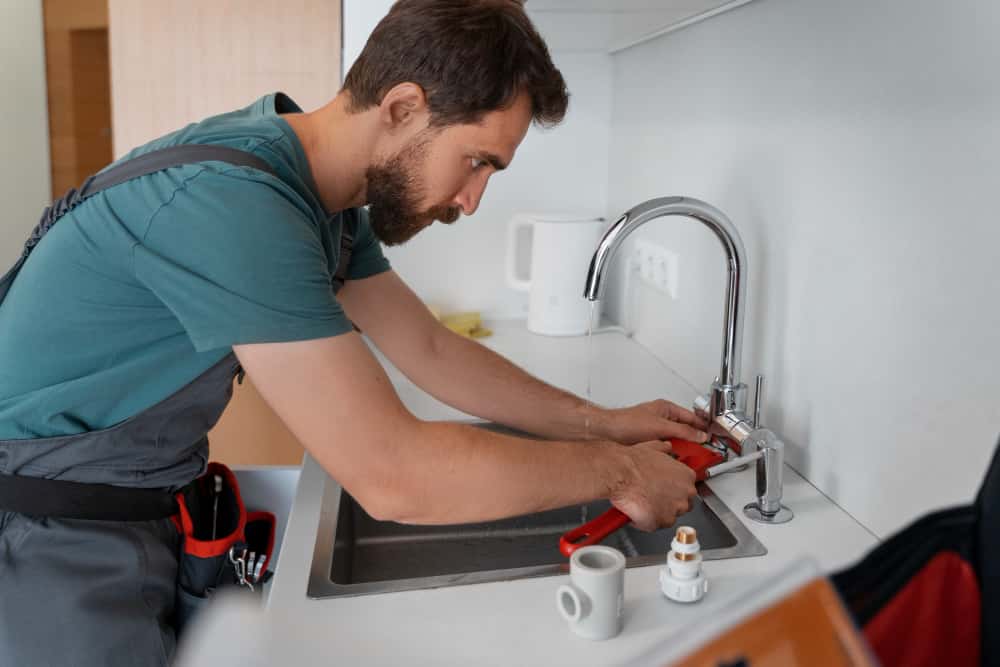
Plumbers install, repair, and maintain the pipes, fixtures, and systems that move water, gas, and waste through homes, commercial buildings, and industrial facilities. On a given day, you might be roughing in supply lines in a new construction house, replacing a water heater in a commercial kitchen, diagnosing a sewer line failure with a camera inspection tool, or running gas lines for a new HVAC system.
The work is physically demanding. You’ll spend time crawling under houses, working in tight crawl spaces, lifting heavy pipe, and standing on concrete for long shifts. You’ll work indoors and outdoors, in all seasons — emergency service calls don’t wait for good weather. That said, most working plumbers describe the problem-solving aspect of the job as genuinely satisfying. Every service call is a different puzzle.
Plumbing also has real specialization tracks. Residential service plumbers focus on repairs and upgrades in homes. Commercial and industrial plumbers work on large-scale systems in office buildings, hospitals, and manufacturing plants — often at significantly higher wages. Pipefitters and steamfitters (a closely related trade) specialize in industrial piping systems for process plants, refineries, and power generation facilities. A pipefitter in a unionized industrial facility in the Gulf Coast or Pacific Northwest can earn well above the national median.
How to become a plumber: step-by-step
There’s no single path, but most plumbers follow one of two routes: a union apprenticeship through the United Association (UA) or a non-union apprenticeship through an open-shop contractor. Both lead to a journeyman plumber license. Here’s how to get there.
-
1
Meet the basic entry requirements Most apprenticeship programs require you to be at least 18 years old, have a high school diploma or GED, and pass a basic math and reading aptitude test. Some programs — particularly union locals — require a drug screen. A few states allow 16- or 17-year-olds to start pre-apprenticeship work under direct supervision, but full apprenticeship registration typically starts at 18. A basic algebra course before applying will help you score higher on aptitude tests.
-
2
Choose your entry path: union apprenticeship, non-union apprenticeship, or trade school Union (UA): The United Association of Plumbers and Pipefitters (ua.org) runs Joint Apprenticeship Training Committees (JATCs) in most US cities. Apply directly through your local UA JATC. Acceptance is competitive — some locals have waiting lists. Starting wages are typically 40–50% of journeyman scale (around $18–$24/hr in 2026 in most markets), rising each year.
Non-union: Independent plumbing contractors and contractors affiliated with the Associated Builders and Contractors (ABC) run their own apprenticeship programs. Entry is often easier and faster than union programs. Wages vary more by employer but are often competitive with union rates in tight labor markets.
Trade school first: Some candidates complete a 6–12 month plumbing technology certificate at a community college or trade school before applying to an apprenticeship. This gives you a foundation in pipe systems, blueprints, and plumbing codes — and can make you a stronger apprenticeship applicant. [INTERNAL LINK: best trade schools in the US] -
3
Apply to an apprenticeship program and get registered Find and apply to an apprenticeship program through apprenticeship.gov or directly through your local UA JATC (ua.org/find-a-local). The application process varies by local — some require a formal interview, aptitude testing, and a physical. Once accepted, your apprenticeship will be registered with the US Department of Labor or a State Apprenticeship Agency (SAA). That registration matters: it’s what makes your hours count toward your license. Never sign on with an employer who won’t register your apprenticeship. [INTERNAL LINK: plumbing apprenticeship guide]
-
4
Complete your apprenticeship: 4–5 years of paid on-the-job training A standard plumbing apprenticeship runs 4–5 years and combines on-the-job training (OJT) with classroom instruction. The OJT requirement is typically 7,000–10,000 hours depending on your state and program — the equivalent of 3.5–5 full years of full-time work. Classroom training covers the International Plumbing Code (IPC), blueprint reading, pipe sizing, water systems, drainage, gas systems, and safety. You’ll advance through defined levels (Year 1, Year 2, etc.) with a pay raise at each step. Keep all of your hour logs and training records — you’ll need them for your license application.
-
5
Apply for and pass your journeyman plumber license exam Once you’ve completed the required hours, you’ll apply to your state’s licensing board and sit for the journeyman plumber exam. Most states use the PSI Exams or Prometric platform to administer the test. The exam typically covers the state plumbing code (most states use the IPC or UPC), water systems, drainage, gas, and math. Passing scores are usually 70% or higher. Exam prep courses are available — and worth taking. Many states also require continuing education (CE) hours for license renewal. [INTERNAL LINK: plumber licensing by state]
-
6
Work as a journeyman plumber (2–5 years) toward master plumber status After earning your journeyman license, you can work independently under a licensed master plumber’s supervision. Most states require 2–4 additional years of journeyman experience before you’re eligible to sit for the master plumber exam — though requirements vary significantly by state. Use these years to build your skill set across specializations: service and repair, new construction, commercial work, and gas systems. This experience also builds the business knowledge you’ll need if you eventually want to run your own plumbing company. [INTERNAL LINK: how to start a plumbing business]
-
7
Earn your master plumber license The master plumber license is the highest level in the trade and is required in most states to pull permits, supervise other plumbers, and run a licensed plumbing contracting business. The master exam is more comprehensive than the journeyman exam — covering system design, code compliance, business law, and project management in addition to technical trade knowledge. Most states require you to pass a master plumber exam administered through PSI or Prometric. In states that require it, there’s also usually a business and law exam component. [INTERNAL LINK: how to become a master plumber]
Union vs. non-union apprenticeship: what’s the difference?
Union apprenticeships (through UA locals) typically offer higher starting wages, better benefits, and structured progression. Non-union programs can be faster to get into and may offer more flexibility. Both produce licensed journeyman plumbers — the path you choose matters less than completing a properly registered program.
To know more about union and non-union apprenticeship, read Union vs Non-Union Skilled Trades: Pay, Benefits & Career Comparison.
How long does it take to become a plumber?
The honest answer: plan for 4–5 years to reach journeyman status, and 7–9 years total to reach master plumber. Here’s how that breaks down:
- Apprenticeship: 4–5 years (7,000–10,000 OJT hours + classroom training)
- Journeyman license: Issued after completing an apprenticeship and passing the state exam
- Master plumber license: Requires 2–4 additional years of journeyman experience after licensure, plus a master exam
If you go the trade school route first (a 6–12 month plumbing certificate program), you add time upfront — but many programs credit trade school hours toward the apprenticeship requirement, which can reduce total apprenticeship time. Check with your specific apprenticeship program before enrolling.
The comparison to a four-year college degree is worth noting: by the time a college graduate finishes a bachelor’s degree, a plumbing apprentice in their second or third year is already earning $25–$35/hr and has no student debt. By the time a college grad has been in the workforce for a year, that apprentice is a licensed journeyman.
Plumber salary: what you can realistically earn
The national median annual salary for plumbers, pipefitters, and steamfitters is $60,090 (BLS, May 2024). That’s a solid middle-class income with no college degree required. But the median doesn’t tell the whole story — your actual earnings depend heavily on your state, your specialization, whether you’re union, and how many hours you work.
The BLS 90th percentile for plumbers nationally is approximately $99,000/yr — and that’s before overtime, which is common in construction and industrial plumbing. Union pipefitters working on industrial projects in states like Alaska, Illinois, Massachusetts, and New Jersey routinely break $100,000+ annually when overtime is included.
Here’s how earnings typically progress through your career:
| Career Stage | Typical Hourly | Annual Estimate | Notes |
|---|---|---|---|
| Year 1 apprentice | $18–$24/hr | $37,000–$50,000 | 40–50% of journeyman scale (union); varies for non-union |
| Year 3 apprentice | $24–$31/hr | $50,000–$64,000 | Progresses annually per program schedule |
| Journeyman plumber | $28–$42/hr | $58,000–$87,000 | Varies significantly by state and sector |
| Master plumber | $38–$55/hr | $79,000–$114,000 | Higher in commercial/industrial; business owners earn more |
| Industrial pipefitter (union) | $42–$65/hr | $87,000–$135,000+ | Oil & gas, power, refineries; includes OT and per diem |
State matters a lot. The top-paying states for plumbers, pipefitters, and steamfitters (BLS, May 2024) include Alaska ($87,900), New Jersey ($89,200), Massachusetts ($87,100), New York ($88,600), and Illinois ($81,200). Lower-paying states like Arkansas ($48,600), Alabama ($50,200), and Florida ($52,400) still offer solid livings — but if maximizing income is your goal, geography is part of the calculation.
Here’s the full breakdown of how plumber’s salary varies state to state. Read Plumber Salary by State in 2026 (Latest BLS Data).
Pro tip
If you want to maximize your plumbing income, look into industrial pipefitting. Pipefitters who work on power generation facilities, refineries, and chemical plants — especially in unionized settings — regularly earn $100,000+ annually once they have experience. The work is more technical than residential plumbing, but the pay reflects that. Many UA locals have separate pipefitter training tracks alongside their plumbing programs.
For a full breakdown of plumber salaries by state, check our skilled trades salary calculator, where you can estimate the salary for different trades in different states for every experience level.
Plumbing license requirements
Plumbing is one of the most regulated skilled trades in the US — and for good reason. A failed pipe in a commercial building can cause serious structural damage and health hazards. Every state (except a small handful) requires plumbers to be licensed, but the structure of those licenses varies.
The three main license levels
Most states use a three-tier licensing system:
Apprentice plumber: Registered with the state and the Department of Labor. Allows you to work on plumbing systems under direct supervision. No exam required — just registration.
Journeyman plumber: Earned after completing your apprenticeship hours and passing the state journeyman exam. In most states, journeymen can work independently but must work under a master plumber’s permit to pull permits.
Master plumber: The highest license level. Requires 2–4 years of journeyman experience (varies by state), a passing score on the master exam, and in many states, a separate business and law component. Master plumbers can pull permits, run their own plumbing business, and supervise other plumbers.
How long does it take to get a plumbing license?
Getting your journeyman plumber license takes 4–5 years from starting an apprenticeship. Getting your master plumber license takes an additional 2–4 years of journeyman experience after that — so roughly 7–9 years from start to master status. The total time investment is similar to a medical or law degree, but you’re earning $40,000–$60,000+ the entire time you’re training.
| State | OJT Hours (Journeyman) | Journeyman to Master Wait | Licensing Body |
|---|---|---|---|
| Texas | 8,000 hrs | 4 years as journeyman | Texas State Board of Plumbing Examiners (tsbpe.texas.gov) |
| California | 8,000 hrs (DAS) | C-36 contractor license path | CA Contractors State License Board (cslb.ca.gov) |
| Florida | 4 years experience | N/A (contractor license model) | Florida DBPR (myfloridalicense.com) |
| New York | Varies by city/county | 5+ years experience (NYC) | NYC DOB / county-level licensing |
| Illinois | 8,000 hrs | 2 years as journeyman | Illinois IDFPR (idfpr.illinois.gov) |
| Pennsylvania | County-level regulation | Varies by county | Local county licensing boards |
One important note: California does not have a statewide journeyman plumber license in the traditional sense. Instead, California plumbers typically work under a licensed C-36 Plumbing Contractor. The path in California runs through the Division of Apprenticeship Standards (DAS) for apprenticeship registration and the Contractors State License Board (cslb.ca.gov) for contractor licensing. If you’re in California, verify the current requirements directly with the CSLB.
Here’s everything you need to know about plumbing licenses in the US: Plumber License Requirements: Apprentice, Journeyman & Master (2026 Guide).
Watch out
Performing plumbing work without the required license is illegal in most states and carries significant penalties — including fines, mandatory stop-work orders, and in some cases criminal charges. Never work under someone else’s license number without their direct on-site supervision. If a contractor asks you to do this, it’s a red flag. Always verify your own license status and understand what your license level permits you to do in your state.
Career path: apprentice to master plumber
Plumbing has one of the clearest career ladders of any skilled trade. Here’s what the full progression looks like — and where the real earning potential opens up.
Apprentice plumber (Years 1–5): You’re learning on the job under journeyman and master plumbers. Your pay increases annually. By Year 4–5, many apprentices are nearly at journeyman scale in terms of technical skill — you’re just finishing out your required hours.
Journeyman plumber (Years 5–9): After passing your state exam, you can work independently on most projects. Many journeymen settle here for their entire career — the income is high, the work is steady, and there’s no business liability. A journeyman plumber in a union setting with consistent overtime can clear $80,000–$90,000+ in high-wage states without ever getting a master license.
Master plumber (Year 9+): The master license unlocks permit-pulling, business ownership, and supervisory roles. In most states you need 2–4 years of post-journeyman experience before you can sit for the master exam. The master exam is harder than the journeyman exam — it includes code interpretation, system design, and often a business and law component. Budget 3–6 months of serious study time.
Plumbing contractor/business owner: With a master license, you can operate your own licensed plumbing company. This is where income ceilings disappear — successful plumbing contractors regularly earn $120,000–$200,000+ annually, though business ownership brings its own risks and responsibilities.
Here’s the comprehensive guide on how to start a plumbing business.
If you are still in the process of deciding which trade skill you should learn in 2026, you can read our comparison of the highest-paying trade jobs in the US.
High-value specializations
Beyond the core apprentice/journeyman/master ladder, certain specializations significantly increase your earning power:
Industrial pipefitting: Refineries, power plants, and chemical facilities. Requires additional certifications (AWS welding certs are valuable here). Union pipefitters in these settings earn among the highest wages in all the skilled trades.
Gas systems: Installing and servicing natural gas and propane systems requires additional state certifications in most jurisdictions. Plumbers with gas endorsements command a premium.
Medical gas systems: Installing piped medical gas systems in hospitals and healthcare facilities requires ASSE 6010 certification. The work is specialized, the pay is excellent, and the competition is limited.
Fire suppression/sprinkler systems: Sprinkler fitters are a related trade with strong union representation and high wages. Many plumbers cross-train into this area.
Union plumbing career
- Structured wage scale, rises annually
- Strong benefits: health insurance, pension, 401(k)
- Industry-standard training through UA JATCs
- Access to large commercial and industrial projects
- Job placement support through the local union
- More competitive to get in; some locals have wait lists
Non-union plumbing career
- Often easier to get started — apply directly to contractors
- Wages vary by employer; can be competitive in tight markets
- More flexibility in employer choice and job type
- Benefits depend on the individual employer
- Training quality varies — vet the program carefully
- Easier path to starting your own business in some states
Frequently asked questions
How long does it take to become a plumber?
It takes 4–5 years to become a licensed journeyman plumber. That time is spent in a registered apprenticeship program combining on-the-job training (typically 7,000–10,000 hours depending on your state) with classroom instruction in plumbing codes and systems. After becoming a journeyman, you’ll need an additional 2–4 years of experience to qualify for the master plumber exam — so plan 7–9 years total to reach master status.
How do you become a plumber apprentice?
To become a plumber apprentice, you need to be at least 18 years old, have a high school diploma or GED, and apply to a registered apprenticeship program. The two main routes are through a UA (United Association) local JATC — find yours at ua.org — or directly through a plumbing contractor running a non-union program. You can also search apprenticeship.gov for programs in your area. Most programs require a basic aptitude test and some require a drug screen.
How do you get a plumber’s license?
To get a journeyman plumber’s license, you must complete a registered apprenticeship (typically 7,000–10,000 OJT hours plus classroom training), then apply to your state’s licensing board and pass the journeyman plumber exam. The exam covers the state plumbing code, pipe systems, drainage, gas, and related math. Most states administer the exam through PSI Exams or Prometric. Requirements vary by state — check with your state’s licensing board for exact hour and exam requirements.
How do you become a journeyman plumber?
To become a journeyman plumber, you need to complete a registered 4–5 year apprenticeship program, log the required OJT hours for your state (usually 7,000–10,000 hours), complete the related technical instruction component, and pass your state’s journeyman plumber licensing exam. Once licensed, a journeyman can work independently on most plumbing projects, though permit-pulling typically still requires a master plumber’s oversight in most states.
How do you become a master plumber?
To become a master plumber, you must first hold a journeyman plumber license and then accumulate 2–4 years of additional post-journeyman experience (the exact requirement varies by state). After meeting the experience requirement, you apply to your state’s licensing board and pass the master plumber exam — a more advanced test covering system design, full plumbing code compliance, and in many states a business and law component. The master license allows you to pull permits, supervise other plumbers, and operate a licensed plumbing contracting business.
How much do plumbers make starting out?
First-year plumbing apprentices typically earn $18–$24/hr in union programs (roughly 40–50% of journeyman scale), which translates to approximately $37,000–$50,000 annually. Non-union apprentice wages vary by employer but are often in the same range in competitive labor markets. Pay increases at each step of the apprenticeship — by Year 4 or 5, most apprentices are earning close to full journeyman wages.
Is plumbing a good career in 2026?
Yes — the fundamentals are strong. The BLS projects approximately 6% job growth for plumbers, pipefitters, and steamfitters through 2034, faster than the average for all occupations. The Associated Builders and Contractors reported 500,000+ skilled trade jobs unfilled in 2026, and demand for residential and commercial plumbing services continues to grow alongside housing construction and infrastructure upgrades. The national median salary is $60,090 (BLS, May 2024), with experienced plumbers in high-demand markets earning significantly more. It’s a physically demanding career, but the income, job security, and path to business ownership are genuinely strong.
Can I become a plumber without going to trade school?
Yes. Trade school is not required to become a plumber — the apprenticeship program provides your formal training. You can apply directly to a registered apprenticeship program with just a high school diploma or GED. Some people choose to complete a short plumbing certificate program at a community college (typically 6–12 months) before applying to an apprenticeship, which can make you a stronger applicant. But it is not a requirement.
If you’re ready to start, the best move right now is to find your nearest UA local JATC and check their application window at ua.org. If the union route isn’t the right fit, search for registered non-union programs at apprenticeship.gov. Applications typically open once or twice a year, so get your high school transcript, GED certificate, and any math coursework together now.
If you want to explore other trade careers, here is our complete guide on:
- How to become an HVAC Technician,
- How to become an electrician.
- How to Become a Millwright (2026 Career Guide)
- How to Become a Welder in the US (2026 Guide)
- How to Become a Carpenter in the US (2026 Guide)
- How to Become a Wind Turbine Technician (2026 Guide)
- How to Become an Elevator Installer and Repairer